Note: This is the second part of a 2-part travel log to Ho Chi Minh City. If you haven’t read the first part, please click here.
**********
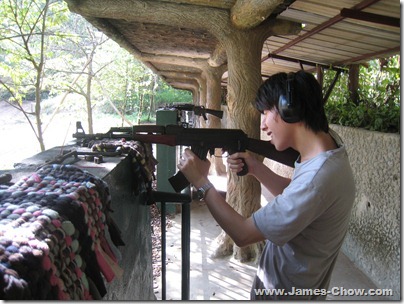
… And so I joined the terrorists team, pressed B-4-1, bought some 39mm rounds.. and… BOOM!! HEADSHOT!!

*Yeah I know I’m holding the rifle wrongly*
LOL.
Please excuse the CS language. Haha this was the first time I fired an AK-47… or any live firearm for that matter! It was pure pwnage!!
Everybody knows that in CS you can easily headshot with an AK – both long and short range. ![]()

It was one of the primary activities at the Cu Chi Tunnels that I’d been really looking forward to… firing a rifle!
We could choose between the AK-47, M16 and M60 rifles (all of which were historically used at the Tunnels during the Vietnam War), and fire them AT WILL at the shooting range!

Of course, you had to pay for the ammo and we paid 300,000 Dongs (approx. RM50) for just ten 39mm rounds.
I chose the AK-47 over the M-16 because most people who had been to National Service (although myself not included) have fired the latter before.
The AK-47, however, is quite exotic and widely perceived to be used by terrorists (LOL thanks to CS) and is therefore more bad ass. ![]()
My rifle’s magazine loaded by an officer:

The firing range was at the end of the Cu Chi Tunnels tour.
So back to the very start, we were made to sit in a comfortable hut in the middle of the jungle and watch a short film documenting the history of the Cu Chi Tunnels and how they were used by Vietnamese guerrillas to fight against the American forces during the Vietnam War.

The story was fine but it was really interesting how much the short film felt like an organized propaganda effort. Many ‘adjectives’ were skilfully used to imply how cruel the Americans were, and video clips illustrating how pitiful the Vietnamese peasants had been during the war… thanks to the aggressors.
After the video our tour guide gave us a short lecture on how the tunnel systems worked and then we were off!

We climbed into these narrow, dimly-lit tunnels that were once used by the Vietnamese guerrillas to hide, communicate, store and generally transport soldiers and supplies without having to risk getting killed over ground.
These tunnel systems were very huge and span many, many kilometres across the area.
And what’s more, the Cu Chi Tunnels are just a part of an even larger network of tunnels existing across the entire country!

It may look easy but it was very exhausting crawling through these bloody tunnels… Your thigh muscles get really worked out as you will need to be duck-walking all the time…![]()
You can imagine the life of the Vietnamese soldiers in these tunnels… what a tough training!
And yeah… here’s a handsome, muscular and manly soldier fearlessly emerging from a tunnel vent.

![]()
The tunnels aside, there were also lots of other war remnants on display…
… such as booby traps! If you were an American soldier and you accidentally stepped on this:

AHHHHHHH!!!! ![]()

… and many other brutal traps that you’d think you’re watching a SAW movie…

Other stuff to see include American tanks that were captured during the war:

Bomb Craters:

HO BOM!~
As well as bombs…

… and landmines recovered after the war:

If so many landmines were used in the war will not help but think if there are any more live ones hidden in the forest grounds of Cu Chi… LOL… So we watched our step! ![]()
At the end of the tour I brought back some spent shells of the three rifles available at Cu Chi as souvenir. Left to right: Rounds of the M60, M16 and AK-47. Wahahahaha!!

**********
The next day we went on another tour, by the same company, to the Cai Be Floating Market.
Cai Be is about 3 hours from Ho Chi Minh City, in the Mekong Delta region. We were brought on a boat and off we sailed towards the floating market.

The floating market is, well… a floating market! Traders basically own their own trading boats, and they would put up goods for sale every morning… just like a regular market!
And buyers would buy from these traders either from the river bank or from their own boats.

I’m not sure why they would prefer to trade this way compared to a physical, landed market. The only two reasons that I can think of are:
1) the dominant mode of transportation in this village is by boat, so it is actually more convenient to do your shopping by boat than by car/bike/foot.
2) Traders don’t have to pay rent! LOL
(or do they?)
It was a little late in the morning when we reached there but apparently the river would have been extremely crowded with boats and market-goers earlier in the morning!

To advertise their goods, the traders would put up a ‘sample’ on a long pole so that prospective buyers can see it from afar.
This boat below, for example, sells turnips:

Imagine someone selling chickens…
… or pork, LOL!
I wouldn’t say it was an incredibly exciting trip but it was certainly worth the experience.
We got to see the not-so-busy side of these traders’ life. In fact, we could see some of them taking a nap or even cooking on their boats… yes, for some of the traders, these boats are also their homes!

It is interesting that a majority of the boats on this river has got a rather ferocious pair of eyes painted in front of them (see pic below). According to the tour guide, they’d been drawn as part of a traditional practise to deter attacks from alligators in the river!
Apparently, the Mekong river had been teaming with alligators back then.
Well I think the practise makes sense. If I were an alligator and I see a huge pair of eyes on a bloody red face cruising barbarically towards me… Well I would just shut up and pretend to be a piece of log. ![]()

Incidentally, the Mekong River is the 10th longest river in the world, with a length of almost 5,000 kilometres spanning across six countries.
After we disembarked, we were invited to visit one of the factories that produce local confections. While I will not dwell in the specifics of the rest of the trip (this entry is getting to long and I want to sleep), I must mention the snake wine:

Snake wine is rather famous in Vietnam and China. It is a gruesome infusion of snakes in alcohol and is claimed to bring lots of health benefits to the drinker, including increased sexual performance! ![]()
The wine was drunk in a shot and tasted horrible. The feeling in my stomach became much more horrible when I investigated what was in the jar:
Layers upon layers of dead snakes lie quietly in the jar along with herbs and other stuff.
I simply took the other ‘stuff’ in the jar for granted and was walking away happily when Tom, a British guy whom we became friends with, ran over to me and asked me to go back to the drinking table and check out what he had ‘discovered’.
On opening the jar, my stomach turned:
HOLY SHIT.
There was a fuckin’ dead bird in my wine!!! Why?? With feathers and all… ![]()
I don’t know!! WHY IS THERE A DEAD BIRD IN MY WINE?????
I couldn’t believe what kind of torture I’d just subjected my stomach to, but we simply felt a wave of nausea and wished each other best of luck and that we would still see each other alive the next morning.
Well, technically we were told that we would be drinking snake wine. That was a grave misrepresentation, wasn’t it? It should have been snake-infused-with-disgusting-dead-bird-with-feathers-and-lots-of-shit-looking-things-wine. ![]()
**********
We dedicated our last day in Ho Chi Minh City to visit the many fine museums and historical buildings within the city centre itself.
The first was the War Remnants Museum:

Having just finished a major war less than 40 years ago, Ho Chi Minh City has got lots of war stuff to display.
Within the compound of the museum exterior was a large arsenal of artilleries, tanks, war planes and helicopters. Many of them were captured from the Americans during the war and still bear the US Army label, such as this Chinook, which you should recognise if you play C&C Generals LOL:
The War Remnants museum was fascinating, although personally, I felt it was more of a propaganda centre. ![]()
The museum basically informs and reminds its visitors of the horrors and atrocities of the Americans during the Vietnam War. With a complete lack of journalistic neutrality, it also featured a major department almost exclusively documenting how ‘evil’ the Americans were. ![]()
The whole exhibition was very dramatic and rhetorical, and at certain points bordering on comical. It began with a tongue-in-cheek display of an excerpt from the US Declaration of Independence, which outlines universal human rights:

… Immediately followed by a photograph with the caption:
“The father of this little girl arrested by (American) GIs. She Implores them: ‘Don’t kill my father’.”

I’m not sure if the ‘don’t kill my father’ part was indeed recorded by the journalist or was simply added in later for dramatic effect.
Right next to it is a photograph of an old man (cropped to show an M-16 rifle held in front of him for maximum rhetorical effect) with the caption:
“A Vietnamese civilian pleads with the 101st Air Cavalry Division soldier who is interrogating him during a ‘search and destroy’ operation in early 1968”

While I sincerely sympathize with the plight of the Vietnamese civilians and concur that the Americans troops were definitely not angels, I utterly fail to see how these photos along with their cheesy captions qualify as ‘war remnants’.
In fact, the incidents, while tragic, are not very historically significant and the whole presentation seemed to exist more for the purpose of generating anti-American sentiment (and love for the newly formed Communist government) than to educate the public on concrete historical facts.
And then all of a sudden it gets much, much more gruesome:
(WARNING: GRAPHICAL IMAGES AHEAD)


There was even an entire gallery dedicated to showing the horrible effects of Agent Orange, an extremely toxic chemical that was used by the US military to clear large areas of forest and track the guerrillas.
These chemicals caused severe biological deformities among victims and the gallery makes sure that you see the most horrific examples:


Yea, I know how you’re feeling. I am not feeling very well too at the moment.![]()
…
So let me stop posting disturbing pictures and instead turn to some REAL, physical remnants of the Vietnam War…
… A real Bazooka, baby!
And Claymore mines! Oh we’ve seen this already in the Cu Chi Tunnels. ![]()

Alright, so moving on we went to the Ho Chi Minh City Museum:

It was a rather short stay as we were short of time. The museum basically emphasizes the history of the city itself, rather than the entire country.
Naturally, a large part of the museum is dedicated to showing how the Communist party was formed, their righteous struggle for independence and noble sacrifices etc.

I noticed something interesting at the exterior of the museum:
It would seem that there were so many war machines left in Ho Chi Minh City after the war that they could give one to EACH museum for display!
Here’s me with a real F-5 Fighter in front of this museum:

**********
And finally we went to our last destination in Ho Chi Minh City – the Reunification Palace.

This can probably be referred to as the White House of Ho Chi Minh City.
Once the palace of the French governor when the city was a French colony, it became the office of the head of the State of Vietnam after World War II.
After the Vietnam War, the palace again changed hands into the ownership of the current Communist government.

Many state functions are held in the palace and the President of Vietnam also has an office in the building.
We could tour most of the state function rooms in the palace for a small fee.
… Found a very iconic bust of Mr Ho Chi Minh in the middle of the banqueting hall! Paid my respect to the man who made this country great! ![]()

We also visited the ‘underground’ parts of the palace, which was used by the previous administration to coordinate troops and run the government during the war.
It was more like a military command bunker with shady corridors and narrow walkways:

We found ‘the War Room of the President’. I guess this is where the President sat and gave orders during wartime:

And this is the ‘Combat Duty Bedroom of the President’ (Well he could’ve used a table lamp instead of TWO bloody telephones):

Yeah so basically that’s it. There were lots of other interesting stuff in the Reunification Palace but I don’t think I can cover them all in this blog post.
Annnnnnnnnd yes, have to mention this one though… ![]()
Didn’t I say that there are war machines (fighter jets, helicopters, artilleries etc.) in almost every museum?
There were TANKS in this one!

Apparently these were the tanks of the North Vietnam army which had barged into the Palace in 1975 and ended the Vietnam War.
I can vividly see how the war ended.
If I were the South Vietnam president at that time and there were enemy tanks like these ridding through my walls and pointing their badass cannons at my room… I’d SOOOO surrender thank you very much.
**********
Before I end this super looooong entry (my laptop is lagging), a tribute to the unbelievably tasty, authentic Vietnamese beef noodles.

I seriously can’t get enough of them. Love ‘em! ![]()


Went to Vietnam last week!

Specifically, we went to Saigon, which was the capital city of South Vietnam and the preceding French colony. Today, there is no more South Vietnam, having been unified with North Vietnam to form, well… Vietnam! ![]()
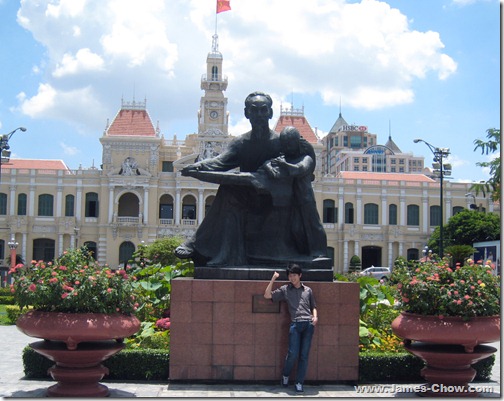
The city’s name was also changed from Saigon to Ho Chi Minh City, in memory of the the great communist leader (pic above) whose shadow I can be seen hiding under to escape the scorching heat!

It was weird because coming from Malaysia, a country much closer to the equator than Vietnam, I was supposed to be well accustomed to the heat… but this was different!
Your skin literally roasts under the sun! I could remember that the mere 10 minutes that my brother and I took to take pictures with Mr. Ho’s statue was sufficient to give us sunburns!
Or maybe it was just an unusually hot day! ![]()

Saigon was one of the cities that were most heavily sieged during the Vietnam war some 40 years ago.
Because of this, one would inaccurately think of Ho Chi Minh City as a relatively underdeveloped and inward city.
I’d expected to arrive in a city where everything was to be complete unfamiliar – language, food, signs, culture, retail brands etc.
I’d also thought that everything would be rather traditional and old-fashioned.
-
I was wrong.


Hah! Nowhere in the world escapes western capitalism and consumerism! ![]()
A stroll around the beautiful city centre dispels whatever notion that communist controlled Vietnam is out of touch with the outside world!
This city is the most important economic centre of Vietnam and its residents are some of the richest in the country.


We spent the first day just exploring the city centre.
One thing about the city that really caught my attention was, despite its development, Ho Chi Minh City still retains much of the cultural and more primitive side of things.
It was absolutely lovely!
For instance, we couldn’t be bothered to visit nice restaurants but instead were drawn to these little street vendors who sell very interesting local food and speak utterly zero English.
We couldn’t communicate at all, but were determined to try whatever it was that they were selling!
This extremely friendly lady tried her best to describe in Vietnamese what her product was, but we could only smile and nod.
We understood nothing but decided to try it anyway!
Well, that’s what traveling is all about right?
In the end we were given a delightful bowl of what looked like soya bean curd with glutinous rice – and it was delicious!

The lady was doing business right in the middle of the footpath and there were absolutely no tables and chairs. So we simply put our bags on the floor and sat on them while we ate. ![]()
We also tasted many special and rather exotic food that were sold by these little portable stalls sprouting out of literally random places.
This is a multi-flavoured glutinous rice with a variety of coconut toppings (didn’t like it really much):

What looked like and probably was roasted pigeon (very yummy):

and a fusion of French baguette and what looked like Malaysian SATAY: (tasted quite good!)

We were a little concerned about the hygiene of such street food that were prepared with uncovered, bare hands and literally sold beside the main road with hundreds of motor vehicles passing by every hour.
But well, neither my brother nor I got food poisoning after that, so I guess they were fine! ![]()
The food aside, the next thing that I immediately noticed around the town centre was political imagery.
This is the first time that I visited a communist-governed country, and was rather taken aback when I saw this symbol placed literally all over the city.

The media that I grew up with was predominantly western-oriented, and as we all know western countries dislike communists.
So here I was facing the hammer and sickle – a symbol of Communism. It was a strange feeling as I had immersed in war movies and games like Red Alert that actively portray these symbols as the ‘enemy’ and yet here I was in its territory and still loving the place.
The third remarkable thing about this city that you will immediately notice is – the sheer amount of motorcyclists!

The number of motorcyclists in the city was absolutely staggering! I made a quick estimation and I think I can safely say that the ratio of motorcycles to cars is approximately 20 to 1 – that’s 95% motorcycles!
We were on the road a couple of times and the taxi driver was like Brad Pitt being chased by a dozen CIA agent cars in a Hollywood movie. He was sounding his horn all the time and even driving onto SIDEWALKS just to avoid the massively overwhelming amount of motorcycle traffic in the city.
Well, I guess if you live in a metropolitan area with a population of 9 MILLION, motorcycles are indeed the best way to get around. ![]()
Anyway, there was a huge market at the middle of the town centre called the Ben Thanh Market. It was really huge and is one of the icons of Ho Chi Minh City.

Since it is an icon, you can expect lots of tourists to visit this place.
Since lots of tourists visit this place, you can expect the prices to go off the roof.
Since opening prices are exorbitant, you can expect lots and LOTS of price bargaining.
… and that was exactly what happened. ![]()

Now I think this happens in most countries, not just Vietnam, and I’d had my fair share of experience in price bargaining at tourist-infested places.
But this was different.
In general, the sales girls here were extremely friendly and approachable, and I would say that they really, really wanted us to buy their stuff.
And due to this reason, price bargaining was actually quite, err… fun, over here. ![]()

Let me explain:
First of all, none of us could understand each other.
So all we did was tapping a price figure on a calculator, passing it to the other, the other would widen his/her eyes in apparent horror at the absurdity of the price, scream ‘noooo… no no no…’, laugh, key in another number, and pass it back to the other person.
This process would repeat for half a dozen times or more before a deal is reached. ![]()
This sounds tedious BUT the good part is that you would use the universal language – laughter – A LOT, and they will be laughing all the time as well!

It was very interesting how they tried to do all sorts of things to make us believe that the goods were worth more than the price we offered!
The girl at the store told us stories in simple, broken English about where the clothes were imported, how good the quality was, and how we wouldn’t be able find it anywhere else in Vietnam… She kept going and going until she contradicted herself at some point, realized that we noticed, and then we all laughed. ![]()
We both knew that the product wasn’t as good as she was trying to portray as, and we both knew that none of us believed it. But it was still good fun!
At night, we had our hotel book for us two tickets for a water puppet show!

Water puppetry is a traditional form of entertainment that is particularly famous in Vietnam.
In this approximately one-and-a-half hour performance, wooden puppets were attached to long rods underneath and controlled by puppeteers behind a screen. The rods were invisible beneath a pool of water and the puppets would appear to be moving over the water.
This tradition is many centuries old and was historically done at impromptu ‘stages’ on flooded rice fields in Vietnam as a form of entertainment among farmers.

The puppets acted out a series of traditional Vietnamese folk stories and legends, and we were each given a booklet that tells the synopses of the stories in six languages. What a fantastic way to learn more about a new culture! ![]()
The puppets were cute, the stories interesting and the acting humorous. This might be nothing more than a puppet show, but the performance was by absolutely no means juvenile or childish.
All music and conversations in the show were produced live on both sides of the stage, and man… everything was so professionally done!

Don’t be fooled by the ‘wooden’ look of the puppets! The puppeteers behind them were masters in what they do and the puppets were made to move so lively and full of expression!
There were even fighting scenes where water was actually splashed onto the some of us on the first few rows, but it was all fine! ![]()
After the show ended, the puppeteers emerged from behind the screen to tremendous applause.

After the show we took a night stroll across the town towards the Saigon river.
Ho Chi Minh City was not at all a quiet and lonely city at night. In fact, there were lots and lots of nightlife venues that were extremely lively and busy!
We also noted the high amount of police presence in the city centre – was this because it is a tourist area, or was it that some big event was coming up?
Vietnam was a colony of France, and so the French built a Notre-Dame Cathedral in Saigon! Named after its famous counterpart in Paris!

All the original building materials for this church were imported from France. Why leh? Don’t trust our south east asian materials? ![]()
The Virgin Mary statue in front of the cathedral became famous in 2005 when it was reported to shed tears! Tears were reported flowing down the right cheek of Mary and caused a tremendous influx of people (literally thousands) that year to gather around the basilica and witness the ‘miracle’.
Despite being night time, we could still see believers gathering around the statue of the Virgin Mary and praying… right there. What a peaceful sight!

The next day, we went on a day tour to two famous destinations located to the north of Ho Chi Minh City – the Cao Dai Temple in Tay Ninh, and the Cu Chi Tunnels. I’ll talk about each of them.
The Great Cao Dai Temple, also called the Tay Ninh Holy See, is the seat (sort of like the religious headquarters) of the Cao Dai religion.
While you may not have heard of it, Cao Dai is a relatively new religion (established in the twentieth century) founded in this very city in Vietnam. It currently has several million adherents across the globe.

I don’t really have a good idea of what this religion is all about. All I know (from the 2-hour tour of the temple and Wikipedia) is that it is sort of a fusion of several religions and political figures.
For instance, Jesus is regarded as a Buddha and the ‘saints’ include an all-star mixture of Mohammed, Napoleon, Jesus, Buddha and Shakespeare (?!). No kidding.
According to Wikipedia, the ‘holy spirits’ of Cao Dai include Thomas Jefferson, Winston Churchill, Vladimir Lenin and Victor Hugo.
I have no idea how and why, but it is so. ![]()

Here’s a large portrait at the front atrium of the temple depicting ‘The Three Saints’ signing a covenant ‘The 3rd Alliance’ between God and man.
The Three Saints are apparently Sun Yat-Sen, Victor Hugo, and a Vietnamese poet called Nguyen Binh Kheim. Beside the picture is a sign explaining the meaning behind the portrait.


At the very end of the temple is an altar with a huge, green, watermelon-like globe with an eye at the front.
This symbolizes the Divine Eye of God overseeing the universe and the Cao Dai adherents basically pray and worship towards its direction.

I can think of a million way to make fun of this subject but in the spirit of respect for religion, I shall refrain.
We were there just in time for the noon mass. At precisely noon, Cao Dai followers entered the temple dressing in flowing robes and began the ceremony. There was a high-ranking priest in front leading the congregation through the prayer chants and hymns.

Those dressed in white are lay followers and those in colour are priests.
We didn’t stay in the temple for too long as it was a place of worship and we were eager to continue to the next destination of our tour – the Cu Chi Tunnels!
I had heard of the Cu Chi Tunnels before I went to Vietnam, of its wartime tunnels, deadly booby traps, and most of all – there’s a shooting range where you could shoot an AK-47 or M16 rifle, or even an M60 machine gun! ![]()
**********
This travel log is getting too long for a single post, so I am splitting it into two parts. Click here for Part 2.


Just received my IELTS results yesterday!

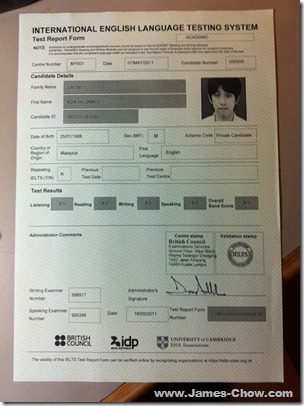
I was quite nervous when I entered the British Council Kuala Lumpur building to collect my results… But well, I didn’t do as bad as I’d thought! Received an overall band score of 8.5 out of 9, with 8.5 for each of the Writing, Listening and Speaking modules, and 9.0 for Reading.
In fact, it’s not bad at all! This score satisfies the conditional offers of all the eight universities that I’m choosing from!
Yay! Now my admission is guaranteed!
I didn’t really have time to blog about the IELTS test day as I was quite busy and also worried in the two weeks after the test. Worried because I believed that I’d screwed up the Writing and Reading papers… especially writing!
The time given for the writing test was one hour, with two questions. We were supposed to spend 20 minutes on writing a report on some chart given to us, and spend the remaining 40 minutes writing a much longer argumentative essay on a selection of topics.
I spent 45 MINUTES on the report (I’d always got this fatal habit of checking and rechecking every sentence I write) and spent the remaining 15 minutes zooming through the second essay. I guess five years of essay writing in university and on this blog helped LOL.
I remember being quite satisfied with the 15-minute express-essay, but as I wrote the words “In conclusion,” at the beginning of the last paragraph, the invigilator horrifyingly announced: ‘stop writing please!’
I hesitated and simply rubbed of the two words… handing up an essay with NO CONCLUSION!
Well, as for reading, I didn’t have time to do the last 4 multiple-choice questions (out of 50), so I simply circled ‘C’ for the remaining questions and laid down my pen. None of us dared to continue writing beyond the time given after witnessing an earlier incident in which a girl had refused to stop writing and the invigilator marched straight up to her desk and literally snatched the answer sheet away from her!
The girl ended up crying at her desk after the incident.
So I really didn’t expect my reading paper to get a perfect 9.0. If I was told that one of my papers got a 9.0, I would’ve expected it to be the listening paper – which I believed I got every answer correct – but it turns out I didn’t.
The speaking test was an absolute joy to attend. We (the candidates) took turns entering these small rooms which felt remarkably like confessional booths in cathedrals! The only difference between confessional booths and our rooms was that we could see the examiner, in my case a cheerful British lady with a most encouraging smile. ![]()
The only scary part about the speaking test was the recording. The examiner would start recording at the very beginning by declaring a solemn statement to the recorder, something like “This is the speaking test of Mr. James K. H. Chow, on the seventh day of May, the question set is 4B and the examiner is XXX.” It sounded like an interrogation and was initially quite scary!
However as she started asking questions it wasn’t so bad after all. In the beginning I was asked to talk about the city in which I lived, whether I liked it, which place I liked best, blah blah blah. She would keep inserting questions to keep me talking.
In the second part she asked me which newspapers I read. That was an easy question so I gladly responded by giving free publicity to The Star, The Edge and the online news portals of BBC and CNN. She asked me what influenced my choice of newspapers and the type of news that I liked to read about. She was so friendly and engaging that I felt like I was taking to a friend! I couldn’t really stop talking and I recall there was one point when I started talking about politics. LOL. Perhaps I shouldn’t have… but she didn’t stop me and kept smiling and nodding patiently…
I think she should change her job and be a psychiatrist instead.
Anyway for the last part of the test, I was asked to describe, in two minutes, a recent news item that I had just read about. I was given one minute to prepare for this ‘mini-speech’.
I could have talked about Osama Bin Laden’s death or a recent development in Anwar’s sodomy case… But since I was talking to a British lady, I decided to talk about the royal wedding of Prince William and Kate Middleton which had happened just a week ago. She seemed exceptionally interested in what I had to say. Luckily I’d watched the entire ceremony live on the internet and the memory was still fresh in mind!
I think the third part may be a little difficult for certain people as the topic given can (potentially) startle you and render your mind blank for the entire one minute that you’re given to prepare the talk. Well for this part I think I should thank my involvement in Toastmasters – guess the Table Topics sessions really helped a lot!
All in all I think my IELTS journey was quite a smooth one. I didn’t really prepare too much for the tests as they coincide with my final project presentation in my university (just days apart). But who cares! Now it’s over and I’ll need to focus on my FYP and final exams!


Click!
Listen to Songs!
See My Pictures!
Watch My Videos!
Play Fun Games!

Void « Default
Life
Earth
Wind
Water
Fire
Light